

 5 octubre 2026
 Author: Dr Crina Heghes
At Consult Lhasa, we work through nitrosamine assessments every week, and one question keeps coming up. How do you set an acceptable intake that protects patients without unnecessarily limiting access to medicines taken for weeks or months rather than a lifetime? On 24th September, the US Food and Drug Administration (FDA) provided an answer.
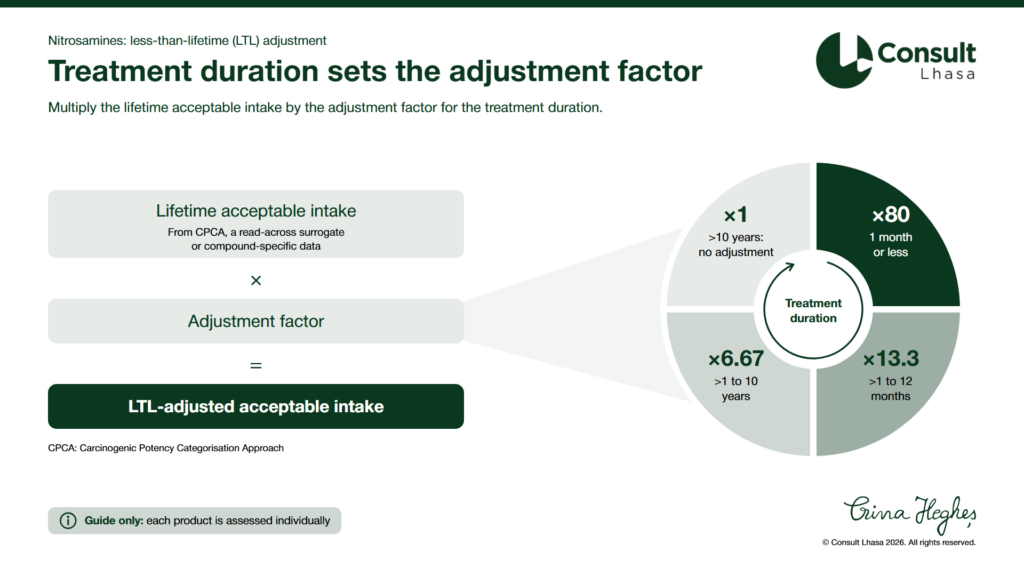
In Application of Less-Than-Lifetime Adjustment to Nitrosamine Impurities, the Center for Drug Evaluation and Research (CDER) confirmed that less-than-lifetime (LTL) adjustment factors from ICH M7(R2) may now be applied to acceptable intake (AI) limits for nitrosamines in products intended for less-than-lifetime use. For treatment of one month or less, the lifetime AI may be multiplied by 80. For more than one month up to 12 months, the factor is 13.3, and for more than one year up to 10 years, it is 6.67. Beyond 10 years, no adjustment applies.
This was made possible through science-led collaborations between industry, academia and not-for-profit organisations including Lhasa Limited.
CDER cited two recent papers by Felter et al. (Regulatory Toxicology and Pharmacology, 2025 and 2026), developed in part through the Health and Environmental Sciences Institute (HESI) Nitrosamines Research Program, which directly addressed open questions on cumulative dose response, DNA repair capacity and polypharmacy.
Dr David Ponting DABT represented both filial de and Consult Lhasa on this work.

One of the fundamental axioms of toxicology is that the dose makes the poison. As a result, it can generally be assumed that a lower exposure, e.g. taking a drug for a shorter time, reduces the risk – the FDA have now accepted this argumentation for nitrosamines.
Dr David Ponting DABT, Lead Scientific Consultant


What does LTL mean for patient safety?
CDER’s response to emerging scientific evidence, and its openness to evidence and arguments that can justify an appropriate safe limit, is to be applauded.
But this does not mean any lowering of the level of patient protection; on the contrary, we should expect careful inspection of any proposal to use the LTL approach. Applying an LTL factor results in the scaling (by multiplication) of the lifetime value, making both the robustness of this starting value and the specific context of use more important. This value can come from the Carcinogenic Potency Categorisation Approach (CPCA), a read-across surrogate or from compound-specific data.
How should industry respond?
From a regulator’s perspective, the larger the scaling factor or the more vulnerable the expected patient population, the stronger the evidence dossier needed. From industry’s perspective, some scenarios will be easier to tackle than others. The graphic below shows some simpler situations and some where there is an advantage in seeking the support of an external expert.
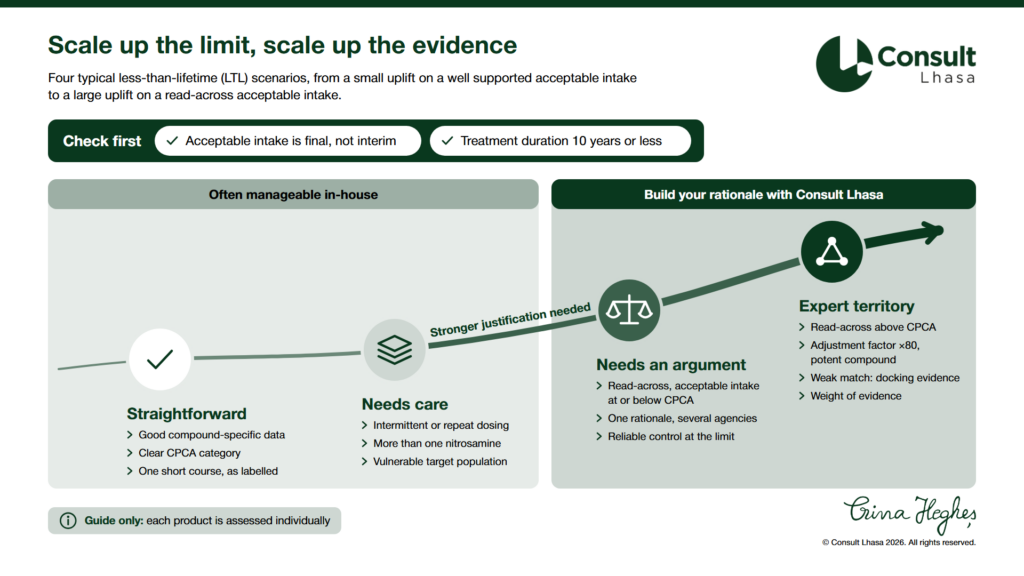
This is where Consult Lhasa can help. Our consultants support organisations with surrogate selection and acceptable intake strategy, including CPCA and read-across, and with docking-based mechanistic evidence where a weight-of-evidence case is needed. Together, those form the scientific foundation an LTL proposal will rest on. We support submissions to regulatory authorities worldwide, building each rationale around the specific problem and the expectations of the agencies involved.
Contact Consult Lhasa
If you would like to discuss your acceptable intake strategy speak to our consultants today.